


In a city where every inch of land is valuable, space is a luxury item. When the footprint of a ‘bed’ may consume one-third of a room, upward growth becomes an inevitable choice. The bunk bed, which was once labeled as a “dormitory” and “children’s room,” is undergoing a profound evolution – from a helpless choice for small layouts to a smart choice for space utilization.
From Single to Multiple: An Evolutionary Graph of Product Types
Today’s bunk beds are no longer as simple as’ bunk beds’. According to material classification, it can be divided into three categories: steel, steel wood, and wood. According to functional classification, it can be divided into child type, student type, and invisible type. The invisible bunk bed achieves the transformation of bed and furniture form through a folding structure, which can be called the “Transformers” of small-sized apartments.
Standard bunk beds are cost-effective and have high space utilization, commonly found in dormitories and other settings. The multifunctional bunk bed integrates a bed, table, and cabinet to meet the diverse living needs of residents. From simple “bed and table” to integrated learning areas, storage areas, entertainment areas, and even parent-child interaction areas, products are undergoing a value transition from “functional furniture” to “growth oriented space solutions”.
Design Revolution: The Great Wisdom of Small Spaces
How to squeeze every inch of value out of a bunk bed in a small space of 8 square meters? The answer is three-dimensional partitioning.
The double decker bed with iron frame has the advantage of three-dimensional space, and the renovation focuses on “utilizing upper and lower partitions+extending and expanding corners”. The upper layer retains sleep function, while the lower layer can be arranged as a reading corner, workspace, or storage space. The staggered structure provides independent activity areas for both the upper and lower bunk beds, without bumping or suppressing. The side of the stairs with widened anti slip design is also equipped with storage compartments, where picture books and toys can be easily placed.
Aesthetics are also upgrading. Modern simplicity, Nordic style, and wooden style are favored. High and low beds are being integrated into the overall home design from isolated items in children’s rooms, and the demand for integrated design with customized wardrobes and bookcases continues to rise. According to data from e-commerce platforms, products with functional modules such as “large capacity ladder cabinets”, “extendable desks”, and “hidden storage” have a sales growth rate 2-3 times that of basic models.
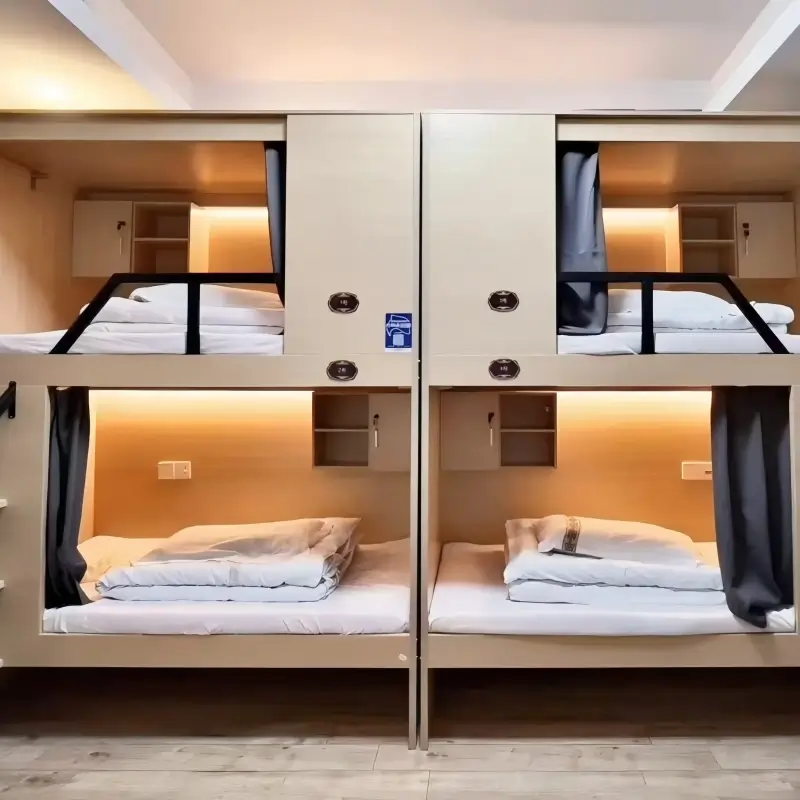
Safety Bottom Line: Hard Constraints in the New National Standard Era
Safety is the bottom line that cannot be touched by bunk beds.
Starting from July 1, 2025, GB/T 28008-2024 “Technical Specification for Safety of Furniture Structures” will be officially implemented. The new standard redefines bunk beds as household and non household bed products with one or more layers of bed surface in the height direction, with a height above the ground of not less than 600mm, a width of not more than 1200mm, and a length of not less than 1400mm. Compared to the old standard, the ground clearance height has been reduced to minimize rolling injuries, and the requirements for width and length have been increased – which means that the upper bunk bed will not be allowed for two people and children to use.
The new standard also adds multiple specific requirements: allowing the connection of safety railings to buildings, the requirement for the ground clearance distance of the first level footboard and stairs, and the distance between the topmost footboard and the access gap. At the same time, the structural requirements for bunk beds have been improved, as well as the requirements for safety barriers on the upper pavement, the length requirements for gaps where safety barriers are interrupted by ladders or other access methods, and stability requirements.
For children’s furniture, GB 28007-2024 “Technical Specification for Safety of Infant and Children’s Furniture” has been enforced from January 1, 2026. The standard specifies the general safety requirements for furniture used by infants and children aged 0 to 14 in terms of material, structure, flame retardant performance, electrical safety, harmful substance limits, and warning signs.
In consumer research, “structural safety” and “environmentally friendly materials” rank among the top two purchasing factors with over 90% attention. Products that meet higher standards (such as the European standard EN747-1) in terms of anti fall design, rounded corners, and the use of formaldehyde free additive sheets, even if the premium exceeds 30%, demonstrate stronger market acceptance