


In children’s outdoor playgrounds, slides have long surpassed a single “sliding” function and become a growth oriented facility that integrates collective training, social interaction, and sensory development. According to statistics, 85% of high-quality kindergartens worldwide have combination slides as standard equipment. With the continuous upgrading of safety standards and the constant innovation of design concepts, children’s slides are undergoing a profound evolution – from simple entertainment tools to “outdoor laboratories” that carry children’s multidimensional growth.
Structural Revolution: From Single Slide to Three Dimensional Growth Space
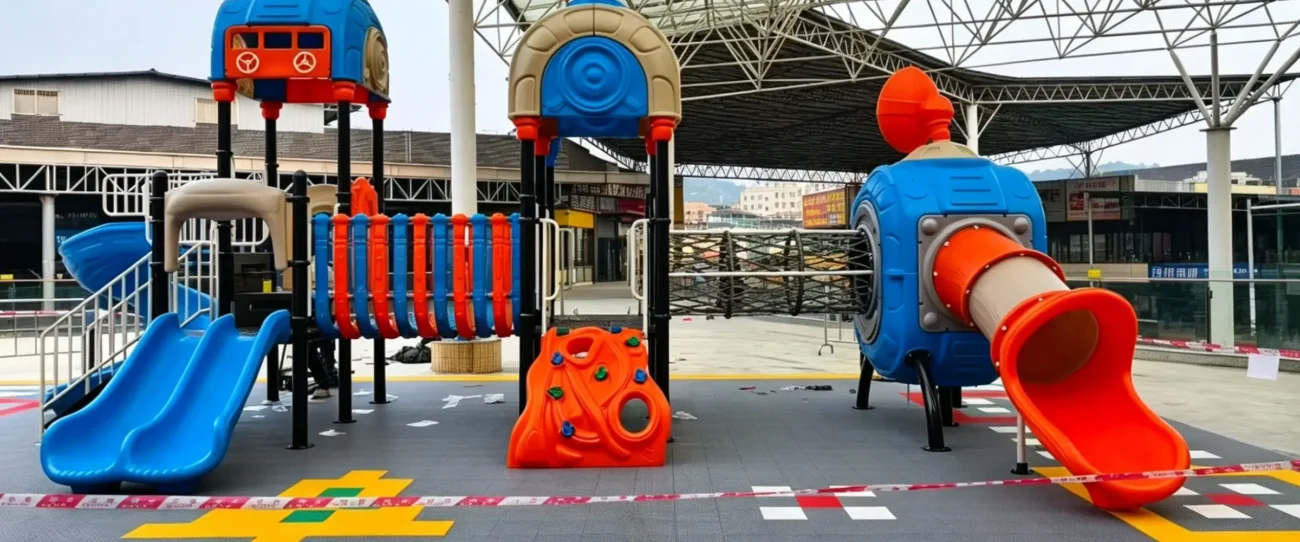
The traditional “vertical ladder+platform” mode of slides is being replaced by multidimensional composite structures. The new generation of combination slides combines the slide with a climbing net, suspended tunnel, and observation deck to form a three-dimensional space with a height difference of up to 1.8 meters. Children need to complete 7 body movements such as grasping, climbing, and balancing to reach the starting point of the slide. This design increases the basic exercise volume of 3-6 year old children by 55%.
From the perspective of structural types, children’s slides are mainly divided into straight slides, rotating slides, wave slides, and spiral slides. The straight slide has a simple structure and slow sliding speed, suitable for young children; Spiral type is suitable for older children and needs to meet higher structural stability requirements. Some high-end products have also launched modular slide systems that support free combination. By switching configurations, they can adapt to different play themes, increasing the reuse rate of facilities by three times
Security Revolution: From Passive Protection to Active Warning
The safety standards for children’s slides have shifted from “passive protection” to “active warning”.
Material safety is the fundamental defense line. The new national standard GB/T 27689-2025 specifies that the slide body must be made of 304 stainless steel with a tensile strength of not less than 78MPa; The tensile strength of plastic parts is ≥ 14.2MPa, and the performance retention rate after aging resistance test is ≥ 90%. Linear low-density polyethylene (LLDPE) is commonly used as the surface material for slides. This material has excellent wear resistance and impact resistance, and can withstand long-term friction and collision without being easily damaged. At the same time, it has good UV resistance, and even under long-term outdoor exposure, it will not experience aging, cracking, or other problems. LLDPE is non-toxic and odorless, meeting the safety standards for children’s products.
The structural design is checked layer by layer. For slides with a height exceeding 3 meters, the strength coefficient of the weld connection is increased to 1.5 times, and the load of the channel offset test is increased to 200kg. The height of the entrance guardrail of the slide is ≥ 1.1 meters, and the edge fillet radius is ≥ 5mm to eliminate the risk of collision. The slope of the slide body needs to be controlled between 25 ° -40 °, and the support frame adopts a triangular stable structure, which can maximize the dispersion of the weight of the equipment itself and the load of tourists.
Intelligent technology is empowering security upgrades. The entrance of the slide is equipped with an infrared sensing device to automatically detect the child’s positioning status; The buffer area uses three-level shock-absorbing materials (surface EPDM rubber+middle memory foam+bottom honeycomb aluminum plate); The support column is equipped with stress sensors to monitor the stability of the structure in real-time. The application of electromagnetic adsorption technology has reduced the rate of injury accidents by 91%. Some high-end products also use nano self-cleaning coatings, which decompose stains and bacteria through photocatalysis, with a bacteriostatic rate of 99.2% and a 40% reduction in maintenance costs
Future trend: Intelligent and environmentally friendly dual wheel drive
The children’s slide industry is ushering in a new round of transformation. The application of composite materials has become a new trend – the combination slide with stainless steel skeleton and HDPE plastic board, which balances durability and safety, is 20% cheaper than all stainless steel. Environmental upgrades are also worth paying attention to, with biodegradable plastics (such as PLA) and FSC certified wood becoming the preferred choices for high-end parks, reducing carbon emissions by 30% compared to traditional materials. Intelligent temperature control technology has also begun to be implemented, and some high-end slides are equipped with thermal conductive coatings, which can control the surface temperature within 40 ℃ in summer.
The evolution history of children’s slides, from a single slide to a multi-dimensional growth space, from passive protection to active warning, is essentially a revolution in the way children grow up. Every climb is an accumulation of muscle strength, and every glide is a leap in spatial thinking. Choosing a slide that integrates safe black technology and educational wisdom is equivalent to creating an exclusive outdoor growth laboratory for children.