


From the moment a child picks up their backpack, a suitable desk has become a “must-have” for countless families. But nowadays, children’s desks and chairs are no longer as simple as one table and one chair. It carries multiple missions of preventing hunchback, protecting vision, and promoting growth, and is quietly supporting a market worth billions.
The ‘Growth Anxiety’ Behind the Billion Dollar Market
The outbreak of the children’s table and chair market is not accidental.
In 2024, the global market size of children’s study desks and chairs is expected to reach approximately 3.69 billion yuan, and is projected to approach 4.88 billion yuan by 2031. In China, the market size of children’s furniture alone has exceeded 180 billion yuan, with desk and chair combinations being the fastest-growing category.
The driving force behind the continuous increase in this number is the growing “growth anxiety” among parents. Hunchback, myopia, scoliosis – these once overlooked health issues have now become the top priority for every family. Data shows that just desks and chairs account for 65% of the total sales of children’s furniture. It is expected that the demand for children’s furniture in China will reach 105.378 million pieces by 2025, a year-on-year increase of 6.2%.
Parents are willing to pay for a proper sitting posture and invest in their children’s healthy future.
The ‘technical content’ of a good chair
Today’s children’s desks and chairs are no longer simply “scaled down” adult furniture.
A set of qualified children’s study desks and chairs, typically suitable for heights ranging from 100cm to 180cm, covering the entire growth cycle from 3 to 18 years old. Its core feature lies in ergonomic design – the desktop can be tilted (adjustable from 0 ° to 40 °), and the height of the table and chairs can be synchronously raised and lowered. Some products are even equipped with visual angle displays to help parents and children accurately grasp the optimal line of sight.
The design of the chair also has great attention to detail. The backrest should conform to the “S” curve of the spine, maintaining a tilt angle of 100 ° to 105 °; The cushion should be able to adjust the depth forward and backward, and provide support with hip shape; The armrest should be adjustable in multiple sections to adapt to different sitting positions. A scientific system that guides children to maintain a standard sitting posture of “three 90 degrees” – ankle 90 degrees, knee 90 degrees, and hip 90 degrees.
Even more cutting-edge products have introduced the concept of “sitting three and standing one”, which helps children develop a study habit of balancing work and rest through sitting posture monitoring and reminder functions.
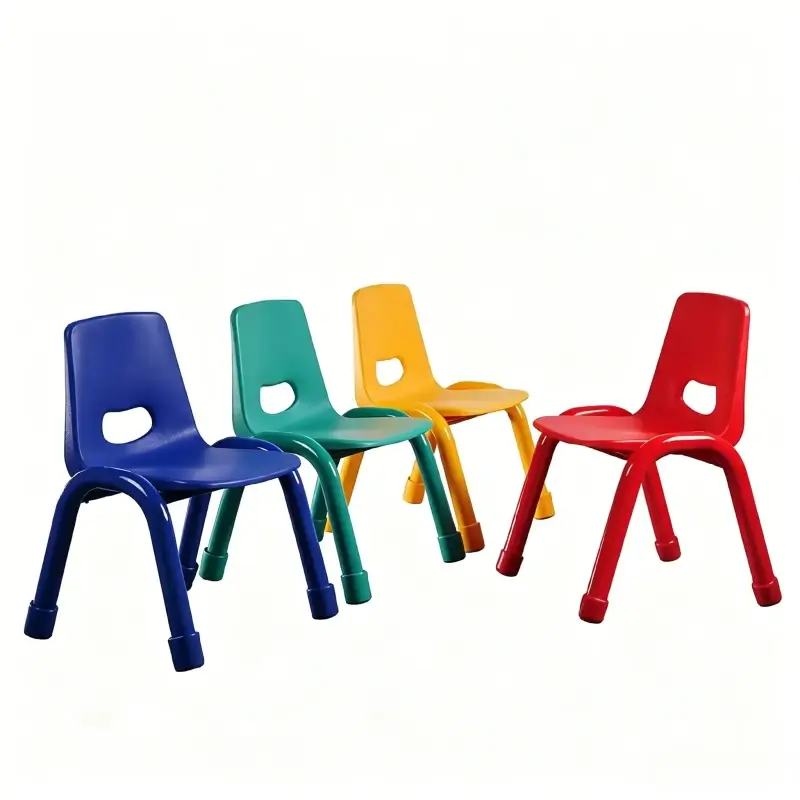
Safety is an untouchable bottom line
The safety standards for children’s furniture are becoming increasingly strict.
On January 1, 2026, the mandatory standard GB 28007-2024 “Technical Code for Safety of Furniture for Infants and Children” was officially implemented. The new standard covers all furniture products used by children aged 0 to 14, and puts forward comprehensive requirements for materials, structure, flame retardant performance, electrical safety, and harmful substance limits. The edge chamfer radius must not be less than 10mm, which means that all sharp edges must be rounded. The release amount of harmful substances has also been set with strict limits to ensure that the air children breathe is clean and harmless.
On February 1, 2026, the “General Technical Requirements for Lunch Break Tables and Chairs for Primary and Secondary School Students” (GB/T 46016-2025) also came into effect, which for the first time specifies the materials, performance, and structure of lunch break tables and chairs, requiring them to have the function of adjusting the lying angle.
Safety is not an option, but a bottom line.